
Storm Cleanup
Storm Cleanup and Yard Debris Around Lake Norman: What to Do in the First 72 Hours
A Mooresville hauler's field guide to the first 72 hours after severe weather around Lake Norman: safety order, insurance documentation, debris sorting, container sizing, and when the town queue is simply too slow.
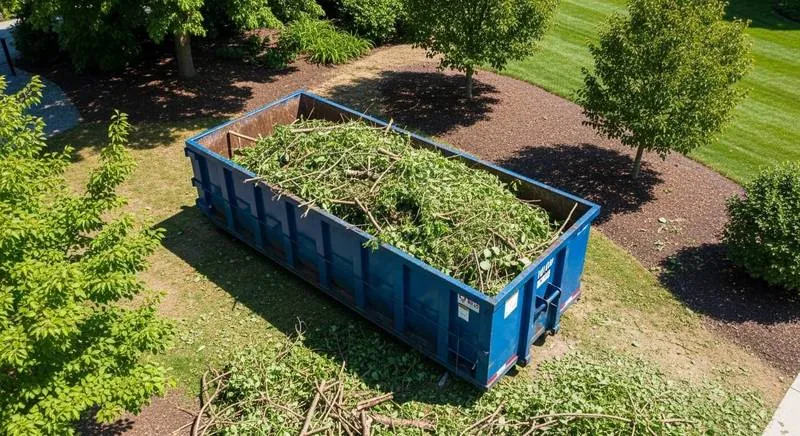
I have been pulling containers out of Lake Norman driveways since 2013, and the calls all sound the same in the first hour after a storm. Somebody is standing in the yard at 6 a.m. looking at a white oak across the fence, wanting to know how fast I can be there. Usually the same day. But what you do in the first 72 hours matters more than how fast the container shows up.
The Weather We Actually Get in Iredell County
People move here and assume the Piedmont is mild. It mostly is, right up until it isn't. Our damage comes from four patterns, each leaving a different mess in the yard.
- Summer severe thunderstorms and straight-line winds. The bread and butter of Mooresville storm damage. A line rolls off the foothills on a July afternoon and 60-to-70 mph outflow winds shear limbs off mature hardwoods across whole neighborhoods. No tornado, no headline, just three streets full of downed canopy.
- Tornado warnings. Iredell County sits in a corridor that lights up several times a year, usually in spring and again in the fall. Most warnings pass without a touchdown; the ones that don't are localized and violent.
- Inland tropical remnants. Gulf and Atlantic systems track up over the Carolinas and arrive here as soaked ground plus sustained wind. Hugo in 1989 is still the local benchmark, and old-timers around Mooresville will tell you about it unprompted. Inland hurricane wind damage is not a coastal-only problem.
- Winter ice. A quarter inch of glaze on loblolly pine is enough to bring limbs down. Hardwoods hold ice longer and drop bigger pieces, usually as a days-long trickle of failures rather than one loud night.
Underneath all of it is red clay. Saturated Piedmont clay loses shear strength fast, and a tree that has stood 80 years will lift its entire root plate out of the ground in a windstorm that would not have touched it in a dry August. That is why storm cleanup here so often includes a root ball, and why root balls wreck weight estimates.
Safety First, and in This Order
Nothing in your yard is worth what it costs to get this wrong. Work the list top to bottom before you touch a single limb.
- Downed power lines. Assume every line is live. Reporting it to Duke Energy is the only correct move. Do not move a limb touching a line, do not move a limb touching a limb that is touching a line, and do not let a kid or a dog into that part of the yard. Energized ground around a downed conductor can shock you through your boots.
- Gas. If you smell it, leave the house, leave the door open, do not flip a switch, and call from down the street.
- Standing water. Floodwater around Lake Norman hides fence posts, septic lids, open drains, and live circuits. Kill the power at the panel before you wade anywhere, and if the panel itself is wet, that is an electrician's job.
- Leaning trees and widow-makers. A trunk leaning against another tree is loaded like a spring. A broken limb hung in the canopy comes down eventually, usually while somebody is under it. Look up every single time.
- Chainsaw reality. Kickback puts the bar in your face in under a quarter second. Storm wood is under tension and compression at once; cut the wrong side of a bent limb and it snaps closed on the bar or whips at your head. Chaps, eye and ear protection, and never alone.
Know where your job ends. Anything overhead, anything near a line, anything needing a rope, anything with a trunk you cannot walk around belongs to a certified arborist or a licensed, insured tree service. You cut what is already on the ground and safely reachable.
Document Everything Before You Clean
This is the step people skip and regret. Before a single branch moves, walk the property with your phone and shoot video and stills: wide shots of the structure, mid shots showing the tree in relation to the house, tight shots of the break points. Then go inside for ceiling stains, wet insulation, buckled flooring, and any water line on the wall. Shoot a flooded basement's contents in place.
Keep every receipt: tarps, plywood, fuel, the tree service invoice, the dumpster. Adjusters reimburse documented mitigation, and a shoebox of receipts is worth real money.
Triage: Make It Safe, Make It Dry, Then Make It Tidy
In that order, every time. The yard can wait. Water in the structure cannot. If the roof is open, get a tarp over it and battened down before dark. Board a broken window, or at minimum get poly and furring strips over it. Move furniture off wet carpet and get air moving. A yard full of brush costs you nothing overnight; twelve hours of rain into an open roof deck costs a ceiling.
Once the building is buttoned up, the debris work starts, and that is where a container in the driveway changes the pace of the whole job. Our yard waste and storm debris removal service exists for exactly this window.
How Much Debris Is Actually Out There
Homeowners underestimate volume by roughly half. A mature willow oak that loses a third of its canopy fills a 20 yard container with brush alone. A whole tree down — trunk, canopy, and root ball — is typically two containers, sometimes three if the trunk gets bucked into rounds instead of hauled off by the tree crew. Brush is bulky and light; it eats volume and barely moves the scale. Wet root balls and clay-caked stumps are the opposite, dense enough to hit a weight limit while the container looks half empty.
| Debris type | Weight vs. volume behaviour | Best container | Where it goes |
|---|---|---|---|
| Clean brush, limbs, leaves | Very bulky, very light; fills fast, weighs little | 20 or 30 yard | Mulch, compost, or grinding facility |
| Bucked logs and trunk rounds | Moderate volume, heavy; stacks tight | 15 or 20 yard | Firewood or wood recycling |
| Root balls and clay-caked stumps | Low volume, extremely heavy; weight limit hits first | 10 or 15 yard | Soil separation, then wood grinding |
| Mixed storm debris (fence, siding, shingles, insulation) | Bulky and moderately heavy; awkward to load | 20 or 30 yard | Transfer station, sorted for recovery |
| Water-damaged drywall, carpet, and pad | Deceptively heavy once saturated | 15 or 20 yard | Landfill disposal |
| Soaked furniture and mattresses | High volume, heavy, does not compact | 20 or 30 yard | Bulky waste stream |
Sort It, Because North Carolina Makes You
North Carolina bans yard trash from lined landfills, and that is not a technicality — it is why clean woody debris is cheaper to handle than mixed debris. Brush and logs go to grinding and mulch. The moment fence panels, shingles, siding, insulation, ruined furniture, and soaked drywall land in that same pile, the whole load becomes mixed waste and prices accordingly.
So make two piles at the curb: wood on one side, everything else on the other. If the storm also took a fence and part of a roof, run those loads separately or at least keep the brush clean. Our guide to recycling and disposal in Iredell County covers where each stream ends up, and the state's solid waste rules are published by NCDEQ.
The Municipal Option and Where It Runs Out
The Town of Mooresville and Iredell County both run yard waste collection and drop-off programs, and after a declared event jurisdictions often stand up special storm debris passes with claw trucks. Use them when they work — they are the cheapest option available.
The limit is timing. After a widespread event everybody's tree is at everybody's curb, and those queues run for weeks. Curbside programs also carry limits on limb diameter and length, and will not take fence panels or drywall at all. If you are selling the house, expecting an adjuster, or simply cannot look at it for a month, a container in your driveway beats the queue. That is the tradeoff we walk through on our residential dumpster rental page.
Flooded Basements and Water Damage
Mold gets going in 24 to 48 hours in a warm, wet Carolina basement, and that clock drives everything. Carpet and pad that sat in contaminated water are gone. Drywall wicks water up from the floor, so cut it a foot above the water line and pull the insulation behind it. Solid wood and metal usually clean up; particleboard, upholstery, and mattresses do not.
Budget for weight. Saturated carpet and wet drywall are far heavier than the same material dry, which is why a basement cleanout often lands in a smaller container than people expect. Our home cleanout checklist lays out the room-by-room order.
Placement Problems Unique to Storm Work
Storm days are the hardest delivery days we have. A tree across the driveway means the container goes on the street or the lawn, and after two inches of rain your clay yard will rut under a loaded roll-off badly enough to need regrading. Tell us the ground conditions when you call. We bring boards, we can set on the apron instead of the pad, and sometimes the answer is waiting a day for the ground to firm up. Our notes on protecting your driveway during delivery apply double when everything is soaked.
Sequencing matters too. Tree crews are slammed for a week after a big event and charge by the hour. If the container is not there when the crew is, you pay them to build a pile you then pay somebody else to move. Ask your tree service for their window and let us know; we will land the container the morning they start. If the job turns out bigger than the yard — a garage crushed, a shed flattened — that shifts into demolition debris territory.
Getting the Size Right
For a limb-out on one or two trees, a 20 yard is the workhorse. For a whole tree down, or a storm that hit the house too, a 30 yard saves you the second haul. Dense material like root balls and wet debris often fits better in a 10 or 15 yard, because weight and not space is the constraint. If you are unsure, our dumpster size guide for Mooresville works through real examples with photos.
Call Us When You're Ready
Race City Dumpster Rental has served Mooresville, Iredell County, and the Lake Norman area since 2013 — locally owned, licensed and insured, flat-rate pricing, and same-day or next-day delivery on storm work whenever the roads let us through. Tell us what came down and where it landed, and we will tell you honestly what size you need. Call (980) 447-6076 or reach us through the contact page, and we will get a container in your driveway.
Questions this guide did not answer? Call (980) 447-6076. We would rather spend two minutes on the phone than have you order the wrong container.