
Roofing
Roof Tear-Off Dumpster Sizing: How to Get It Right the First Time
How to size a roll-off for a shingle tear-off using squares, pitch multipliers and real shingle weights, plus placement, heat, driveway protection and swap-outs on Mooresville and Lake Norman roofs.
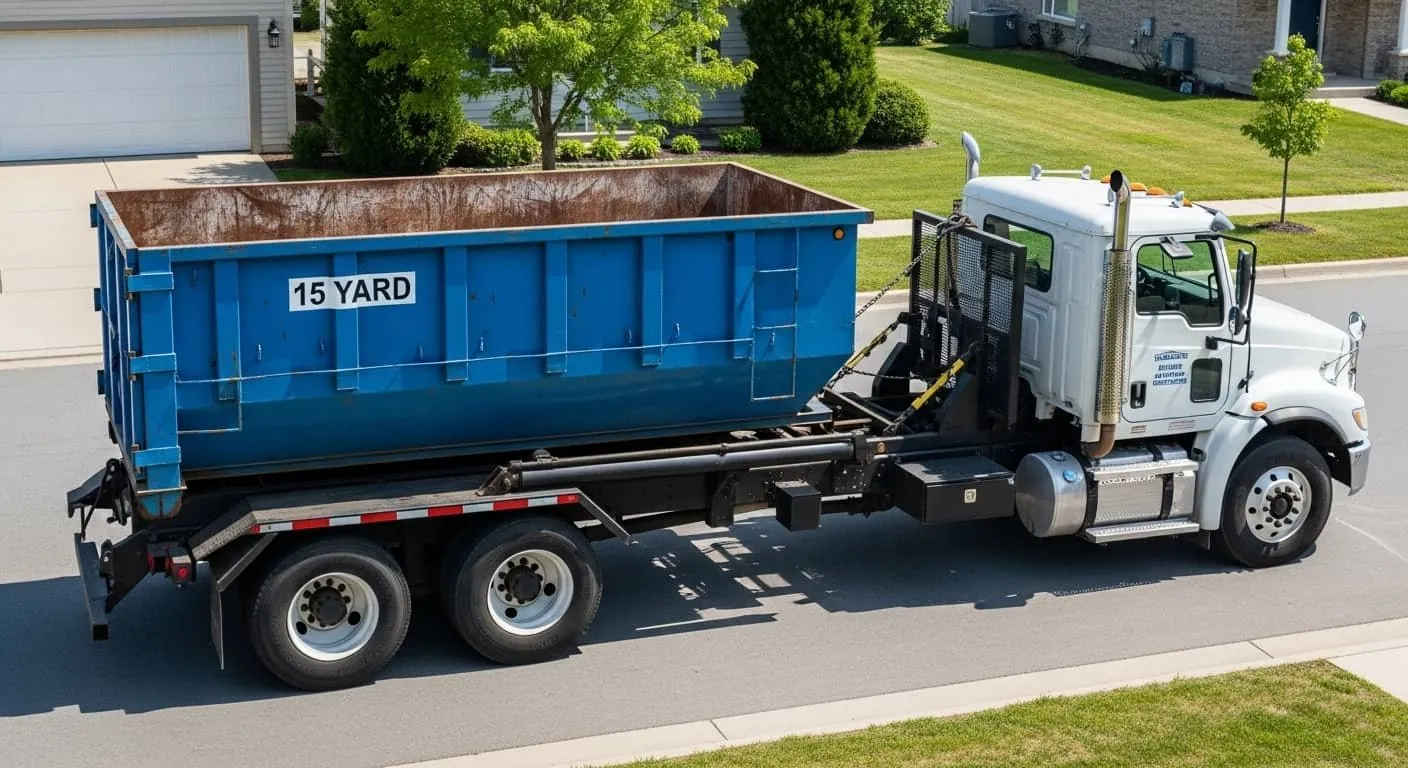
I have been dropping cans on roofing jobs around Mooresville since 2013, and the one thing that separates a smooth tear-off from a miserable one is almost never the crew. It is the container. Wrong size, wrong spot, wrong day, and you have four guys standing on a hot roof at 11 a.m. with nowhere to put 30 squares of shingles. Get it right and the whole roof comes off before lunch.
Roofing debris is dense, dirty, sharp, and heavy in a way that catches people off guard. A can that looks half empty can already be over legal road weight. So let's size a roofing can the way a contractor does it — with squares, layers, and pounds, not eyeballs.
Start With Squares, Not Square Feet
A roofing square is 100 square feet of roof surface. Every shingle bundle, every estimate, every dump ticket in this trade runs on squares, so that is where your math should start too.
The mistake homeowners make is using the house footprint as the roof area. A 2,000 sq ft ranch does not have a 2,000 sq ft roof. You have to add for overhangs and — this is the big one — for pitch. Roof pitch is rise over 12 inches of run, and each pitch has a multiplier:
- 4/12 (gentle, common on older ranches) — multiply footprint by about 1.05
- 6/12 (the Piedmont standard) — about 1.12
- 8/12 — about 1.20
- 10/12 — about 1.30
- 12/12 (full 45 degrees) — about 1.41
That multiplier is what bites people on the custom homes off Brawley School Road and around Lake Norman. Those steep, cut-up roofs with dormers, turrets and multiple gable ends can carry 35 to 40 percent more surface than the footprint suggests, plus waste from all the valleys and hips. I have watched a homeowner order for 22 squares on a house that tore off at 31. Take the footprint, add roughly 10 percent for eaves and rakes, multiply by pitch, then add 8 to 10 percent for waste on a complicated roof. Divide by 100. That is your squares.
The Weight Math Nobody Runs Until It Is Too Late
Here is where roofing gets expensive if you guess. Rough working numbers I have proven out on hundreds of loads:
- Standard 3-tab asphalt: roughly 220–250 lbs per square
- Architectural / dimensional shingles: roughly 350–450 lbs per square
Run that on a typical Lake Norman home. A 25-square architectural roof at 400 lbs per square is 10,000 lbs — five tons — and that is bare shingles only. You have not counted the felt or synthetic underlayment, the nails, the ridge vent, the drip edge, the step and counter flashing, the pipe boots, or the two or three sheets of rotten decking you always find over the porch. Add 8 to 15 percent for all of it. Now you are pushing six tons on one house.
Layers Change Everything
North Carolina code has historically allowed a second layer of shingles over the first, and plenty of contractors took that shortcut through the 80s and 90s. On pre-1990 houses in central Mooresville, out toward Statesville, and in the older Iredell County neighborhoods, a second layer is common and a third is not rare. Two layers doubles your tonnage. Three triples it. A 20-square house with three layers of 3-tab is roughly the same weight as a 60-square single-layer roof.
Before you order anything, go up and lift a shingle at a rake edge or look at the exposed edge at the gable. Count the layers. That one minute of work is worth more than any online calculator.
Sizing Table: Squares to Tons to Container
| Squares (single layer) | Approx. weight — 3-tab | Approx. weight — architectural | Recommended container |
|---|---|---|---|
| Up to 10 sq | 1.1–1.3 tons | 1.8–2.3 tons | 10 yard |
| 10–20 sq | 1.3–2.5 tons | 2.3–4.5 tons | 15 yard |
| 20–30 sq | 2.5–3.8 tons | 4.5–6.8 tons | 20 yard |
| 30–40 sq | 3.8–5.0 tons | 6.8–9.0 tons | 20 yard + swap-out |
| Any roof, 2 layers | Double the figures above | 20 yard, plan on a swap | |
| Any roof, 3 layers | Triple the figures above | Two 15s or staged 20s | |
Why 15 and 20 Yard Cans Are the Workhorses
For residential tear-offs, the 15 yard roll-off and the 20 yard roll-off handle the overwhelming majority of what we deliver. They have low enough walls that a guy on the ground can pitch into them, they fit a normal driveway without eating the whole thing, and their capacity lines up with what a shingle load actually weighs.
The question I get every week: "Why not just send the big one?" Because with shingles you hit weight long before you hit volume. A 30 yard container is built for bulky, light material — framing lumber, siding, cabinets, household cleanouts. Fill one with architectural shingles and you have a truck that is illegal to move. Roll-off trucks have axle limits and North Carolina has weight enforcement; an overloaded can does not leave the driveway, period. It sits there until the crew pulls material back out by hand, which is the single worst afternoon in this business. On roofing, the smaller box with a swap-out is always faster than the big box you cannot lift. If you want the broader breakdown across all our sizes, our Mooresville dumpster sizing guide lays it out job by job, and our roofing dumpster service page covers what is included on a flat-rate roofing can.
North Carolina Heat and Asphalt
July and August in the Piedmont routinely put roof-deck temperatures at 150 degrees or better. Asphalt shingles soften, the tar strip goes tacky, and torn-off shingles weld themselves into one solid mat in the bottom of the can. Two things follow from that:
- Load in the morning. Start at first light, get the tear-off down by noon. Cooler shingles break clean, come off in sheets, and stack instead of gluing.
- Expect the mess. Granules go everywhere, and hot tar leaves black marks on concrete and on any car parked within pitching distance. Move the vehicles. Sweep granules off the driveway the same day — they grind into concrete and stain it.
Heat also matters for the driveway itself, which is the next thing.
Placement, Driveway Protection, and Nails
Put the can on the tear-off side of the house, parallel to the eave you are starting on, close enough that a shovel-load can be pitched straight over the wall. Every extra step is time. Most crews run the tarp-and-slide method — tarp on the ground below the eave, shingles slide down, then the tarp gets dragged and dumped over the rail. That works when the can is within 10 to 15 feet of the drip line. Carrying bundles across a yard in August is how crews slow to a crawl by 10 a.m.
Keep the container off new concrete, off pavers, and off any stamped or decorative flatwork. Pavers shift under point loads and will not go back right. We bring driveway protection boards standard — plywood under the rails and under the wheels — because asphalt drives in Piedmont summer heat go soft and roll-off wheels will press dents into them that never come out. If you want the details on how we set a can without marking up your surface, read our writeup on protecting your driveway during dumpster delivery.
Last step, and it is not optional: roll a magnet. A tear-off drops thousands of nails. Run a rolling magnet over the driveway, the walkways, the beds, and the lawn perimeter — twice, in perpendicular passes — before the crew leaves. Nails in a tire cost more than the roof warranty is worth in goodwill.
Storm Damage and Insurance Work Around Lake Norman
Hail and straight-line wind move through Iredell County most springs, and after a real event the whole lake goes into claim mode at once. Adjuster inspections typically run one to three weeks out, and the ACV check follows. Once approval lands, homeowners want the roof done immediately — which means every roofer in the region is calling for cans the same week.
If you are a contractor working claims, tell us your approved backlog and we will hold capacity. Verify your roofer is properly licensed for the work through the NC Licensing Board for General Contractors before signing anything — storm chasers follow hail into this market every single year.
What Can Ride Along, and What Cannot
A roofing can will take everything the tear-off generates: shingles, felt and synthetic underlayment, plywood and OSB decking, ridge vent, drip edge, flashing, pipe boots, fascia, soffit, and the gutters if you are replacing those too. Small volumes of siding and trim from the same job are fine.
What cannot go in: propane torches and cylinders, sealant and adhesive cans with wet product, solvents, roofing kettles or unspent tar, fuel cans, batteries, tires, paint, and appliances with refrigerant. North Carolina bans several of these from landfills outright — NCDEQ publishes the current disposal restrictions, and the EPA covers handling of household hazardous waste. Anything containing asbestos — some very old built-up roofing and mastics — requires certified abatement and never goes in a standard can. Our guide to what can and cannot go in a dumpster in Iredell County has the full list.
Swap-Outs on Big Roofs
On anything over 30 squares, or any multi-layer tear-off, plan the swap before you start. The move is simple: we set the can the evening before or first thing that morning, the crew fills it, they call when it is at the fill line, and we pull it and set an empty in the same footprint. On most Mooresville and Cornelius addresses we can turn that in a couple of hours if we know it is coming. Surprise swap requests at 3 p.m. on a Friday are the ones that stretch. For larger commercial and multi-building roofs, our construction dumpster service handles staged deliveries and rotating cans.
Get Your Roofing Can Set
We are locally owned, licensed and insured, and flat-rate — no surprise fuel or environmental fees stapled onto the invoice. Same-day delivery when the schedule allows, next-morning as standard, and standing accounts for roofing contractors who need cans dropped without a phone call every time. We serve Mooresville, Davidson, Cornelius, Huntersville, Troutman, Statesville and the rest of the Lake Norman service area. Tell us your squares, your pitch, and your layer count and we will tell you exactly what to put in the driveway — check current Mooresville dumpster rental pricing, then call Race City Dumpster Rental at (980) 447-6076 and we will get it set before your crew climbs the ladder.
Questions this guide did not answer? Call (980) 447-6076. We would rather spend two minutes on the phone than have you order the wrong container.