Delivery & Placement
Will a Dumpster Wreck My Driveway? How Delivery Actually Works — and How We Protect Your Concrete
A Mooresville hauler explains how roll-off delivery really works, where the weight lands, what each driveway surface can take, and the protection boards and prep that keep your concrete intact.
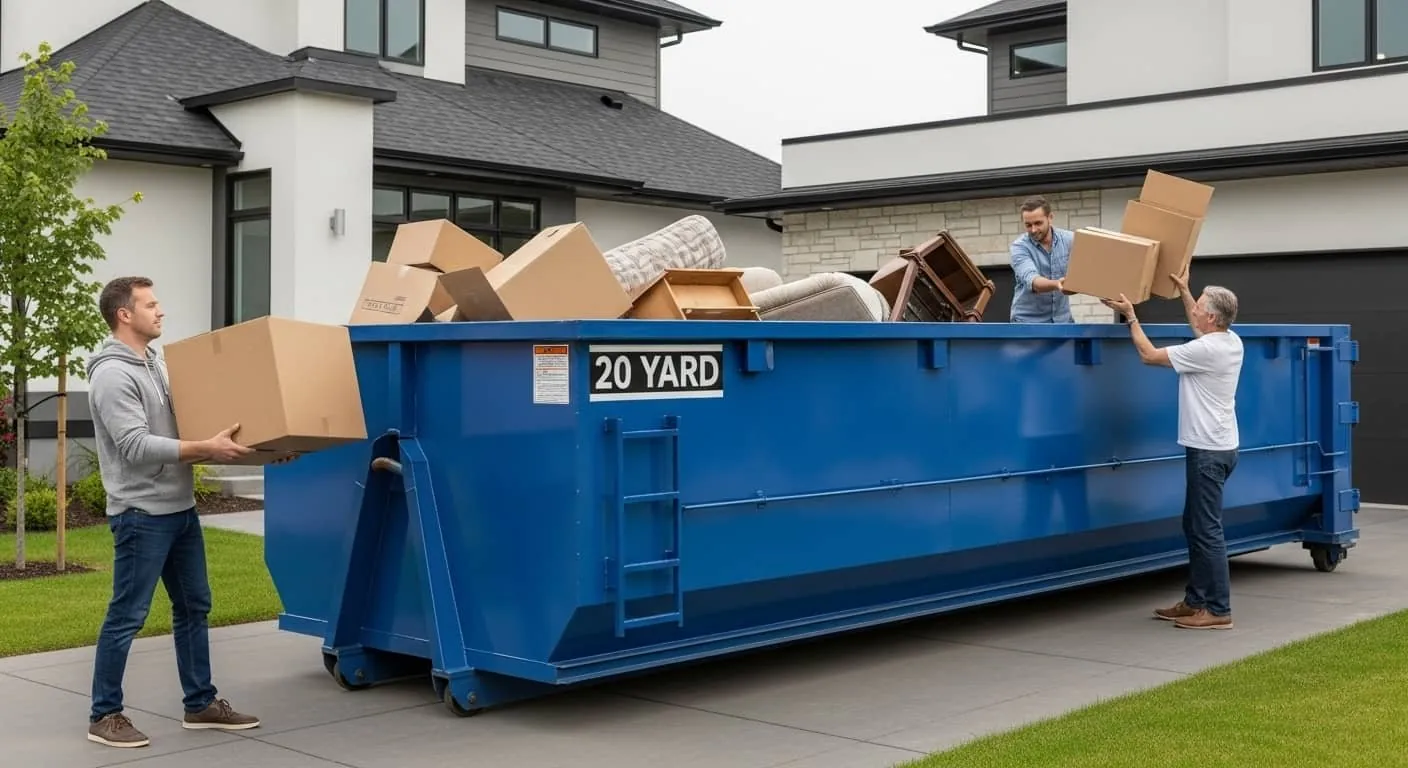
I get this question on the phone more than any other, usually right after someone asks about price. "Is that thing going to tear up my driveway?" It's fair. A loaded roll-off is one of the heaviest objects that will ever sit on residential concrete, and around Lake Norman we've got everything from twenty-year-old asphalt to stamped decorative aprons to lakefront grades that would make a driver sweat.
The honest answer: in the vast majority of Mooresville deliveries, nothing happens. No cracks, no marks. But that's because we plan for it, not because the risk isn't real. Here's how delivery works, where the pressure lands, and what we do about it.
How a Roll-Off Delivery Actually Works
People picture a crane setting a box down gently. That's not it. The truck backs into position with the container still on the rails. The driver raises the hoist, tilting the bed until the back of the can touches down. Then the winch pays out and the container rolls down on four small steel wheels, and the truck pulls forward out from under it.
That gives you two distinct pressure events, and they're different problems:
- The roll. For eight to twelve seconds, the container's weight rides on four steel wheels, each with a contact patch about the size of your palm, moving across your surface. That rolling point load is what gouges asphalt and shifts pavers.
- The sit. Once it's down, weight transfers to the two long steel rails on the bottom. Static load, spread over more area — but it's there for days, and by the end it can be five times what it started at.
The Numbers That Matter
An empty 20-yard roll-off runs roughly 4,000 to 5,000 pounds of steel — a couple of tons before you throw the first shingle in. Household junk puts you at 3 to 4 tons total. Roofing tear-off, drywall, or wet lumber, 6 to 8 tons. Concrete, brick, dirt, or tile can push 10 tons or more, which is why we cap those loads and put heavy material in a 10-yard container instead. Our Mooresville sizing guide covers which one fits your project.
Now divide 10 tons by four steel wheels during the roll. That's the whole story in one sentence.
What Your Driveway Surface Can Actually Take
Poured Concrete
Four inches over a compacted base — what most Mooresville subdivisions built since the 90s have — handles a roll-off fine. The failure mode isn't a crushed slab; it's hairline cracking at or near a control joint, where the slab was already designed to crack. Older slabs, thin pours, and driveways with visible spalling are the ones to watch. Boards handle it.
Stamped and Decorative Concrete
Structurally strong, cosmetically fragile. The sealer and raised texture are what scuff — steel wheels burnish or scrape the high points, and that shows. We board these without exception, and I'd rather use the street or a flat spot in the yard than risk a decorative apron.
Asphalt — The Real Problem
This is the one that costs people money. Asphalt is a flexible pavement held together by a binder that softens with heat. On a July afternoon in the Piedmont, a black driveway surface can hit 140°F or more, and at that temperature steel wheels will emboss it permanently — four dimples, and sometimes a set of drag marks. The fixes are simple: schedule morning delivery when the surface is cool, use full sheets of plywood under the wheel path and rails, and keep the rental short in peak summer. Asphalt older than about ten years, or freshly sealcoated asphalt, gets extra material under it.
Pavers and Brick
Individual units on a sand setting bed. They don't crack so much as move — a wheel catches an edge, a paver tips, and now you've got a low spot and a lipped joint. Edge restraints along the driveway border are the weak point. Boards spread the load across many units at once, which is exactly what a paver drive needs.
Gravel
Ruts and displacement. Gravel takes the weight but not the concentration, so you get trenches where the wheels traveled and a berm alongside. After a hard Piedmont rain the base goes soft and a truck can sink. Gravel usually needs a rake-out afterward — that's normal, not damage.
Lawn Placement
Red clay is the issue. Dry, Iredell County clay is nearly as good as a gravel pad. Wet, it turns to soup, and a loaded truck cuts ruts six inches deep that take a tiller and new sod to fix. We'll set on grass when the ground is firm and you accept flattened turf — not in the two or three days after heavy rain.
| Surface | Risk Level | What We Do | What You Should Do |
|---|---|---|---|
| Standard poured concrete | Low | Boards under wheels and rails; walk the slab first | Point out existing cracks, joints, and any slab under a year old |
| Stamped / decorative concrete | Moderate (cosmetic) | Full plywood coverage across the entire travel path | Consider street or side-yard placement instead |
| Asphalt | High in summer heat | Morning delivery, continuous board coverage, shorter rental window | Tell us the age of the surface and any recent sealcoat |
| Pavers / brick | Moderate to high | Wide boards spanning many units; slow, straight approach | Flag soft or settled areas and loose edge restraints |
| Gravel | Moderate (cosmetic) | Boards under rails; straight-line approach to limit turning | Skip placement for 48 hours after heavy rain |
| Lawn / red clay | High when wet | Assess ground firmness; decline placement if saturated | Mark irrigation heads and septic components before we arrive |
| New concrete (under ~30 days) | Do not place | Relocate to street or alternate pad | Give us the pour date — this one is non-negotiable |
The Fix: Boards, and Why They Work
Every residential delivery we run at Race City Dumpster Rental includes driveway protection boards. It isn't an upsell and you don't have to ask. We lay 3/4-inch plywood or dimensional lumber under the wheel path and under where the rails come to rest.
It's simple load distribution. A steel wheel puts roughly 2,500 pounds on 20 square inches — about 125 psi, plenty to dent hot asphalt. Put plywood under it and that same load spreads over several hundred square inches, so the surface never sees a point load. Boards under the rails do the same job for the days the can sits there filling, which matters most on roofing tear-offs and heavy concrete and masonry loads.
Measuring Your Space Before We Roll Up
The container footprint is the easy part. Plan on about 22 feet long by 8 feet wide for a 20-yard, a foot or two less for a 10 or 15; a 30 is taller, not much longer. Add three feet of clearance on each side so the driver has room and you can walk around it.
The truck is what people forget:
- About 60 feet of straight approach so the truck can line up and back in without jackknifing. A tight cul-de-sac or a sharp turn at the street changes the plan.
- About 23 feet of overhead clearance at the drop point, because the hoist tilts the bed nearly vertical.
- A firm, reasonably level pad where the can lands.
Look Up, Then Look Down
Overhead is where most cancelled deliveries come from: power drops and service lines to the house, cable and phone lines sagging across older Mooresville streets, limbs over the driveway, basketball goals on the apron, garage-door trim and low eaves. Twenty-three feet is higher than people picture.
Below grade matters too. Irrigation heads and valve boxes crack under a wheel. Septic tanks and drain fields will not take a 10-ton static load — if you're on septic, we need to know where the lid and field lines are before the truck moves. Same for propane lines and buried invisible-fence wire, which nobody remembers until it's cut. For anything digging-adjacent, NC 811 is a free call.
Slope, Grade, and Lakefront Driveways
Plenty of Lake Norman homes have driveways that drop hard toward the water. A roll-off has wheels — it is a container designed to roll. We won't set one where gravity gets a vote: not on a steep grade, not facing downhill toward a house, garage door, or bulkhead. If the flat spot is at the top of the drive or out at the street, that's where it goes.
New Concrete: The One Hard Rule
Concrete reaches most of its design strength in about 28 days. A slab poured last week looks finished and is not. Don't put a loaded roll-off on concrete less than roughly a month old — and if you just paid five figures for it, give it longer and use the street. Tell us the pour date when you book.
Liability, Honestly
We're licensed and insured, and our drivers walk the drop before they back in. If we do something careless — ignore a marked sprinkler head, back over a mailbox, drop where you told us not to — that's on us and we make it right. What no reputable hauler covers is ordinary wear: hairline cracking on a slab that was already compromised, flattened grass, gravel that needs raking. Every hauler in Iredell County has that language, and anyone who says otherwise isn't being straight with you. Here's who's driving the truck.
Your Five-Minute Prep Checklist
- Move every vehicle out of the driveway — including the one parked "off to the side."
- Roll trash and recycling bins clear of the approach path.
- Move the portable basketball goal.
- Flag sprinkler heads, septic lids, and soft spots with a stake or spray-paint dot.
- Unlock gates if the drop is behind the house.
- Text us a driveway photo if you're unsure. Ten seconds, saves a wasted trip.
When the Street Is the Better Answer
Sometimes the driveway isn't the spot — brand-new stamped concrete, too steep a grade, or a lot where the only approach runs over the drain field. Street placement is a legitimate fallback and we do it regularly. It generally requires a right-of-way permit from the Town of Mooresville or, on a state-maintained road, from NCDOT, plus reflective markers overnight. Our Mooresville permit guide covers it, and we'll tell you straight whether your address needs one.
Not Sure? Have Us Look First.
A site check costs nothing. Send photos or have us swing by — we run Mooresville, Davidson, Cornelius, Troutman, Statesville and the rest of the Lake Norman area, and we've seen most of these driveways before. Call (980) 447-6076 or get in touch and we'll walk your approach, pick a placement that protects your property, and quote a flat rate with the boards already included.
Questions this guide did not answer? Call (980) 447-6076. We would rather spend two minutes on the phone than have you order the wrong container.